
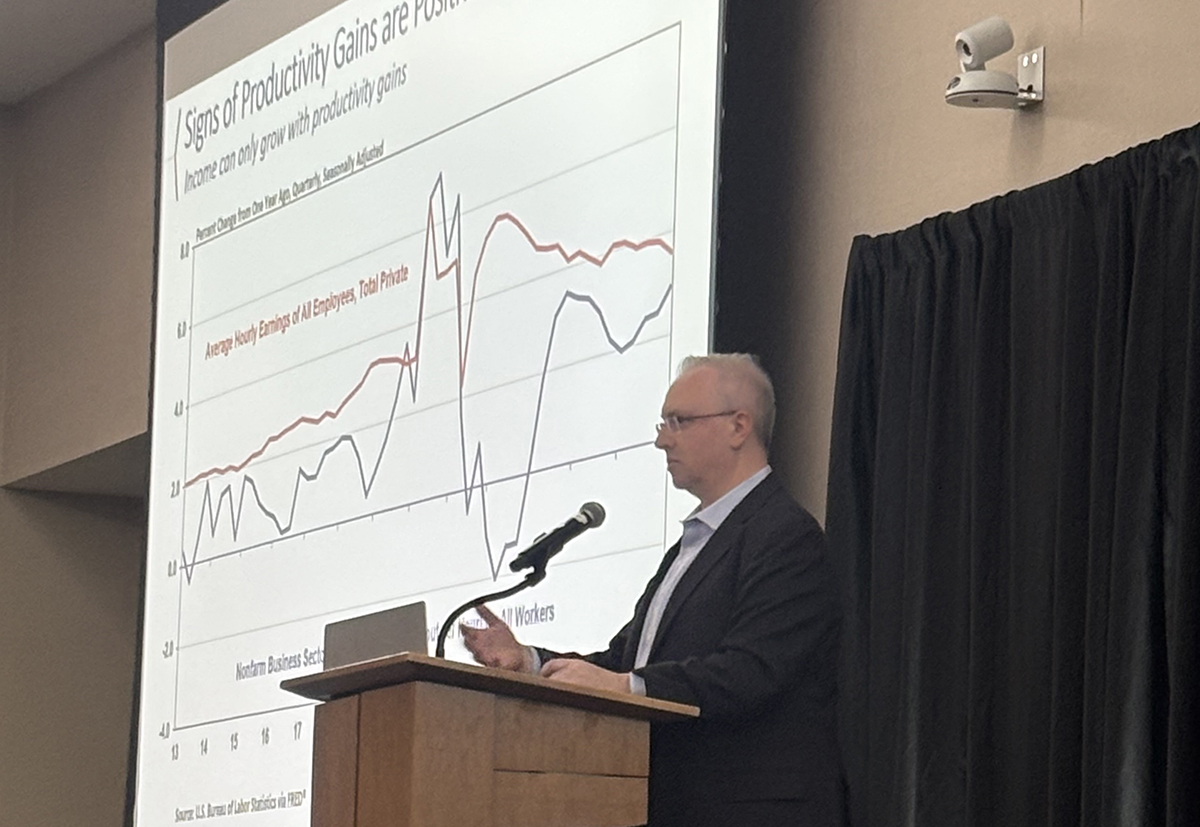
NAHB economist points out some positive aspects in the current economy.
Story By Tracy Dickinson | October 2026
The Iowa City Home Builders Association held its monthly meeting late September. Guest speaker was Dr. Robert Dietz, economist for the National Association of Home Builders. Much of his presentation was on the dark side. However, he said there are some bright spots in the economic outlook. And Iowa is at the heart of that.
“The one bright spot in the current numbers is productivity,” Dietz said. “We’re seeing an improvement there, which means wages will increase as a result. That’s exactly what’s needed to strengthen the economy.”
Dietz said the new chair of the Federal Reserve is working toward this same goal, seeking to improve productivity, which spurs higher wages and ultimately offsets higher prices.
In other areas, Dietz was less optimistic. Delinquent loans, for example, are becoming a concern. The number of delinquent mortgage loans is low, except for FHA loans. But other loan categories are experiencing high delinquency rates more recently.
“Auto loans are a huge issue,” Dietz said. “One-third of car loans are currently under water, with borrowers owing more than their cars are worth.”
Credit card delinquency rates are also high. And student loans are “a mess,” he said, after promises of loan forgiveness programs and borrowers assuming they wouldn’t have to pay back those funds.
One reason those delinquency rates may be so high is the state of the job market. Nearly one in three months has seen job losses since tariffs, he said.
“In all of 2025, the number of jobs created totaled what used to be the monthly average,” Dietz said. “Since the unemployment rate is somewhat low, that might seem odd. But that’s primarily because so many people have left the market and stopped looking for work.”
Iowa, in fact, has one of the weakest job markets, with numbers nearly the same as 2020, likely an effect of the drop in agricultural exports for the state.
“The number one challenge to the housing market and the economy as a whole is the war in the Middle East,” said Deitz. “Nothing the Fed does will affect that, so interest rates are unlikely to change any time soon.”
Other countries have slowly begun selling off U.S. treasuries. Dietz says that could have an effect on long-term interest rates as well. Concerns over the next election and potential policy changes could exacerbate this and spur further sell-offs.
“Government spending is a major issue,” said Dietz. “The debt-to-GDP ratio sits at 100%, and that has to change.”
While the national numbers may be rather pessimistic, Dietz was moderately more optimistic about the Midwest and Iowa in particular. “A lot of housing markets around the country are starting to level off, but Iowa is holding on. Some communities are even seeing double-digit growth,” he said.
Tariffs have affected some segments of the supply market such as aluminum. Other segments such as lumber have been surprisingly unbothered. The supply and materials costs of new construction are rising faster than inflation, with prices up about 8% in the last year.
“Regulatory costs are having a huge impact on home prices,” said Dietz. “Up 40% in the past five years, the cost of regulation averages $130,000 for new construction. If we’re going to address the need for affordable housing, we have to get regulatory costs in line at every level.”
Looking at the housing forecast, Dietz said Iowa is beginning to see increases in single-family housing starts, which is a positive sign for the market as a whole.
“The strength of the national housing market is the Midwest,” said Dietz. “Nearly every region seeing positive numbers is in the Midwest.”
Dietz said he expects millennials will drive the market for the next five years or so. But each succeeding generation is likely to see decreases in growth or even a decline in population.
“As Gen Z and Gen Alpha enter the housing market, we’re going to see the effects,” Dietz said. “Gen Alpha is the smallest generation in more than 100 years, and Gen Beta may be even smaller.”
Despite those negative factors, Dietz said construction of custom homes continued to rise, even when the market as a whole was down. “The custom market and the remodeling market are bright spots for the construction industry nationally. Remodeling is flat right now as a result of cautious consumer spending. But I anticipate it will grow steadily over the next decade.”
With more homeowners opting to stay put, an inventory of older homes, and increased focus on aging in place, the remodel market will continue to grow in the future. Builders who want to remain viable may need to expand their reach into remodeling as well as new construction.
A dark cloud may have hung over much of what Dietz had to say. But occasional bright spots offered a glimpse of potential areas of growth, including the housing market right here in Iowa.