
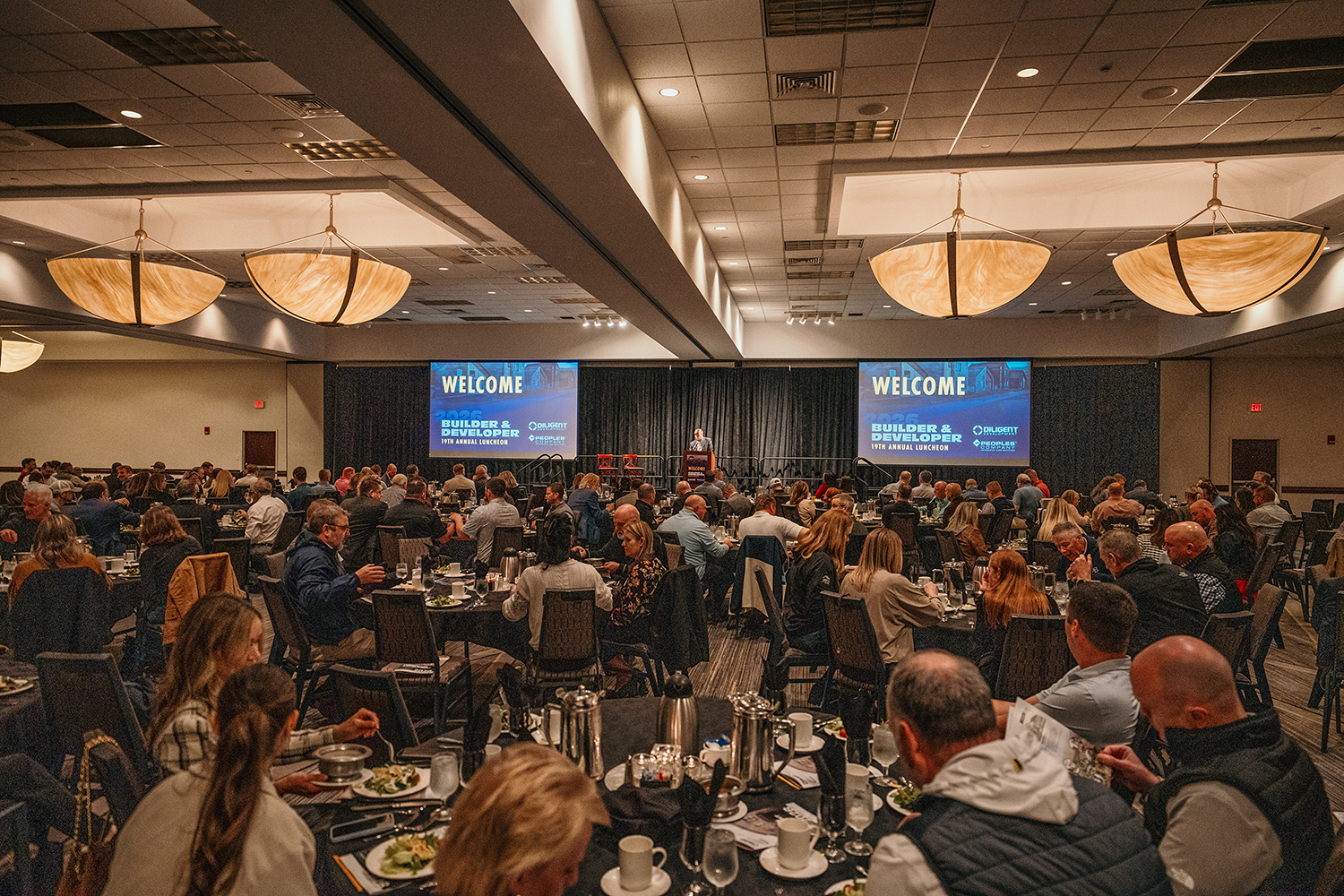
19th Annual Builder Developer Luncheon speakers emphasize foundational principles.
Story By Tracy Dickinson | April 2026
Peoples Company and Diligent Development hosted the 19th Annual Builder Developer Luncheon in March at the West Des Moines Sheraton. The luncheon ended on a positive note with a look at the local real estate market. However, this year’s event offered a less than rosy perspective of the housing market and the national economy.
As Danushka Nanayakkara-Skillington, economist for the National Association of Home Builders, said in her opening segment, “Although this is a macro-economics, big-picture perspective, housing is life, so stabilizing the housing sector helps stabilize the economy.”
Nanayakkara-Skillington shared a realistic, though not terribly optimistic, outlook on the U.S. economy, pointing out that unemployment is up, inflation is rising faster than wages, and shelter costs (which make up 40% of inflation) have risen 27% in just the past five years.
“We lost 90,000 jobs in February,” she said, “and 2025 saw the weakest job growth in the past 20 years, aside from the ’08 recession.”
She also noted that the recent military conflict in Iran had an immediate effect on oil prices, which resulted in rising gas. “We’ll have to see how this affects supply costs long-term,” said Nanayakkara-Skillington, “but any extended increase in gas prices will have an effect.”
When the conversation turned to interest rates, she said economists were watching a couple of factors that could play into any changes this year. “The mandate under which the Federal Reserve operates is to maximize employment and tame inflation. Most economists anticipate rate cuts. We’re watching to see how the change in leadership at the Fed that’s supposed to happen in May could affect those decisions.”
Slow changes in interest rates have been a factor in the slightly slower housing market over the past year, especially with homeowners who might otherwise have been considering moving up to a larger or more expensive home. “With 20% of existing mortgages currently financed below 3%, switching to a mortgage that’s over 6% is not very appealing to those buyers,” said Nanayakkara-Skillington. “Combine that with rising consumer debt, which is up 44% since 2022,” and most potential buyers are approaching the market with caution.
Although Nanayakkara-Skillington said those statistics indicate a less than stellar market for 2026, there are some other statistics that could indicate long-term concerns. The disparity between home prices and household income is one of those factors. “Home prices have risen more than 200% in the past 25 years,” she said, “while income has risen just 93% during that period. We currently have six million young adults still living with their parents, and the median age of first-time buyers is now 40 years old.”
She said this situation, along with the declining birth rate, could have far-reaching effects.
“Home ownership plays a major role in net wealth. And if Americans are unable to purchase a home, that has long-term implications on their financial situation,” she said.
Despite some rather pessimistic numbers, Nanayakkara-Skillington noted some positive signs for the housing industry. “On the whole, the U.S. has an aging inventory and an aging pool of homeowners. Both of those will result in resale and remodel activity. And the large number of Americans working from home will also have an impact on those markets.”
Kalen Ludwig of Peoples Company and Diligent Development closed the event with her annual look at the local market. Dubbed a “recalibration,” 2025 was a steady year for the Des Moines metro, with most statistics normalizing after several years of erratic activity. (For a look at the entire report, visit Ludwig’s website at NewConstructionSpecialistDSM.com.)
Although interest rates didn’t drop as much as hoped, Ludwig said buyers are returning to the market anyway. “Steadier rates have brought some comfort as people have begun to make life decisions rather than rate decisions.”
The stability of the Des Moines market has also reassured potential buyers. Home values have remained strong while appreciation has moderated over the past year or so.
Despite some spikes between 2024 and 2025, Ludwig said the average annual growth rate over the period was 3.4%, which is historically consistent.
Activity around the metro also remained consistent with past years. The top communities were again Ankeny, Waukee, and Urbandale. Other suburbs, such as Adel, Altoona, and Carlisle, saw more-balanced numbers as 2025 ended.
“Grimes and Indianola both saw a jump in activity in 2025,” said Ludwig. “Grimes saw an increase in lots under development, and Indianola ended the year with a stronger level of inventory than 2024.”
Ludwig says the communities tracked showed positive numbers as they entered 2026, with most either up from 2024 activity or more balanced after some volatile years. The metro as a whole saw averages consistent with that of the past decade.
“The market has room to build,” she said, “and decisions made now will affect availability and pricing in the future.”
If Nanayakkara-Skillington is right and housing is life, then life in central Iowa remains on a solid foundation.